
Braces vs Invisalign: Which Is Better?
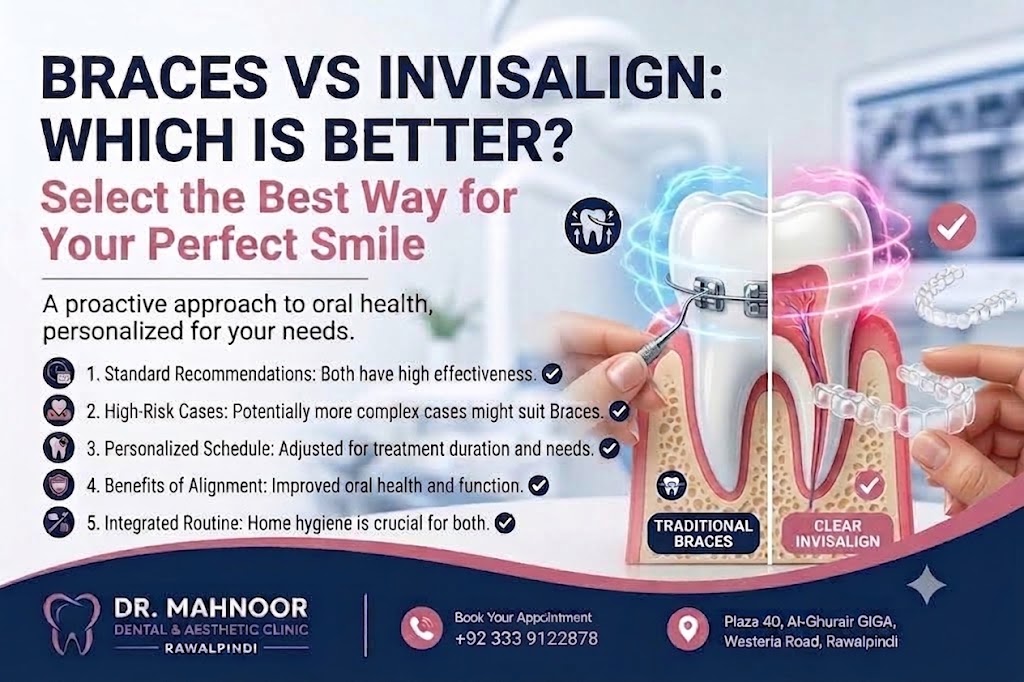
If you’re considering straightening your teeth, you’ve likely come across the braces vs Invisalign debate. Both options can give you a straighter, healthier smile, but they work differently and suit different needs and lifestyles.
At Dr. Mahnoor Dental & Aesthetic Clinic, we help patients decide between braces vs Invisalign as part of our orthodontics treatments, based on their individual goals, budget, and orthodontic needs. In this guide, we’ll compare both options so you can make the right choice for your smile.
What Are Braces?
Traditional braces use metal or ceramic brackets bonded to the teeth, connected by an archwire that gradually shifts teeth into proper alignment. They are adjusted periodically by your dentist or orthodontist throughout treatment.
What Is Invisalign?
Invisalign uses a series of clear, custom-made aligners that gradually move your teeth into position. Each set of aligners is worn for about one to two weeks before switching to the next in the series, with no brackets or wires involved.
Braces vs Invisalign: Which Is Right for You?
Choosing between braces vs Invisalign depends on several factors, including the complexity of your case, your lifestyle, and your personal preferences. Let’s break down the key differences.
1. Effectiveness
Braces are highly effective for complex orthodontic issues, including severe crowding, bite problems, and significant misalignment. Invisalign works well for mild to moderate cases but may not be suitable for very complex corrections.
2. Appearance
This is often the deciding factor in the braces vs Invisalign comparison. Braces are visible on the teeth, while Invisalign aligners are clear and far less noticeable — a popular choice for adults and image-conscious patients.
3. Comfort
Braces can cause irritation from brackets and wires, especially after adjustments. Invisalign aligners are smooth plastic and generally more comfortable, though some pressure is normal as teeth shift.
4. Removability
Braces are fixed and cannot be removed until treatment is complete. Invisalign aligners are removable, allowing you to eat, brush, and floss without restrictions — though they must be worn 20–22 hours a day for best results.
5. Maintenance and Oral Hygiene
Braces make brushing and flossing more challenging due to brackets and wires. With Invisalign, you simply remove the aligners to maintain your normal oral hygiene routine.
6. Treatment Duration
Treatment time varies by case complexity for both options, though Invisalign often works slightly faster for mild to moderate alignment issues, while braces may be necessary for longer, more complex cases.
7. Cost
Both braces and Invisalign have a range of costs depending on the complexity of your case. Your dentist can provide a personalised estimate after an initial consultation.
8. Discipline Required
Braces don’t rely on patient compliance since they’re fixed in place. Invisalign requires discipline, as aligners must be worn consistently to stay on track with your treatment plan.
Braces vs Invisalign: Pros and Cons at a Glance
Braces
- Best for complex cases
- No compliance required
- More visible
- Can cause initial discomfort after adjustments
Invisalign
- Nearly invisible
- Removable for eating and cleaning
- Requires discipline to wear consistently
- Best suited for mild to moderate cases
How Is Treatment Planned and Performed?
At Dr. Mahnoor Dental & Aesthetic Clinic, the process typically includes:
Step 1 – Consultation and Examination Your dentist examines your teeth, bite, and jaw alignment to determine the best treatment option.
Step 2 – Treatment Planning X-rays or scans are taken to create a personalised plan, whether for braces or Invisalign.
Step 3 – Fitting Braces are bonded to the teeth, or your first set of Invisalign aligners is provided.
Step 4 – Ongoing Adjustments Braces require periodic tightening visits, while Invisalign patients switch to new aligners at home and attend regular check-ins to monitor progress.
Step 5 – Retention After treatment, a retainer is used with both options to maintain your new, straighter smile.
Does Treatment Hurt?
Both options can cause mild discomfort, especially in the first few days or after adjustments. This is a normal part of the teeth-shifting process and typically subsides within a few days.
Benefits of Straightening Your Teeth
- Improved appearance and confidence
- Easier to clean, reducing risk of decay and gum disease
- Better bite function, reducing strain on jaw joints
- Corrected speech issues in some cases
- Long-term oral health improvement
According to the American Association of Orthodontists, both traditional braces and clear aligner systems like Invisalign are effective, well-established methods for correcting misaligned teeth when used as directed.
Why Choose Dr. Mahnoor Dental & Aesthetic Clinic?
Patients choose our clinic because we provide:
- Experienced dental professionals
- Personalised guidance on braces vs Invisalign based on your case
- Modern diagnostic equipment
- Comfortable, patient-focused treatment environment
- High standards of sterilisation
- Comprehensive dental services under one roof
Whether you’re leaning toward braces or Invisalign, our team is here to help you choose the option that best fits your smile goals.
Frequently Asked Questions
Is Invisalign as effective as braces?
For mild to moderate cases, Invisalign can be just as effective. For more complex orthodontic issues, braces are often the better option.
Which is more affordable — braces or Invisalign?
Costs vary based on your specific case and treatment length. A consultation will give you an accurate comparison for your situation.
Can adults get braces, or is Invisalign better for adults?
Both options work well for adults. Many adults prefer Invisalign for its discreet appearance, though braces remain effective for complex cases.
How long does treatment take with braces vs Invisalign?
Treatment time depends on the complexity of your case rather than the option alone — your dentist can provide a personalized timeline.
Do I need to wear a retainer after braces or Invisalign?
Yes, a retainer is typically required after both treatments to maintain your results long-term.
Book Your Appointment Today
Still deciding between braces vs Invisalign? A personalised consultation is the best way to find the right option for your smile.
The experienced team at Dr. Mahnoor Dental & Aesthetic Clinic provides expert guidance to help you choose between braces and Invisalign with confidence.
Contact us today to schedule your Appointment and start your journey to a straighter smile.
Ready for a Healthier, Brighter Smile?
Book your consultation with Dr. Mahnoor today and receive personalized dental and aesthetic care in a comfortable, modern clinic.